
Wednesday, April 20, 2005
New Google Accessibility Problem
Talk about bad accessibility caused by trying too hard; yesterday, I had an argument with my colleague Dominik Schmid about which Internet Explorer (if any) shipped with Windows 95. We were in the train, so I started my Nokia Netfront Access mobile browser, which can handle the normal Google.com just fine. I wanted to enter “Internet Explorer 3 Release Date” trying to trigger the Google Q&A feature which is perfect for small screens (it gives the direct answer fast).
Except, now Google.com automatically forwarded me to Google.com/xhtml. This forced forward must be a new setting as so far, Google.com worked fine (it would display the German version, but that was not a big deal). The bad thing about Google.com/xhtml is that it doesn’t contain all Google features – especially, Google Q&A is missing.
Again: a separate mobile HTML version is not needed for Google.com. If anything, Google could convert their current homepage into XHTML1 Strict and serve separate, media-specific stylesheets. But Netfront Access actually understands all kinds of HTML fine (HTML from the beginning had platform-independence built-in).
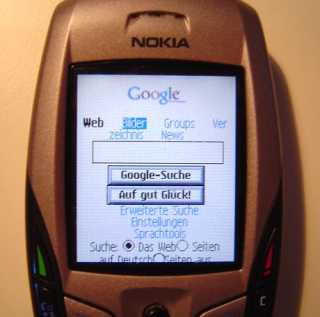
The old Google.com homepage was perfectly usable on my Nokia 6600.
In other words, Google – by trying to create a version of their homepage specifically tailored at the mobile platform – made it impossible for me to make good use of their search engine via my hand phone.
But what about the argument I had with my friend? Which browser version was released with Windows 95? While Google Q&A didn’t provide an answer after all, this Microsoft history page did:
“In July 1995, Microsoft released the Windows 95 operating system, which included built-in support for dial-up networking and TCP/IP (Transmission Control Protocol/Internet Protocol), key technologies for connecting to the Internet. In response to the growing public interest in the Internet, Microsoft created an add-on to the operating system called Internet Explorer 1.0.”
In other words, there was no IE at all in the first version of Win 95 – apparently, it was only included in the Windows 95 Plus pack CD.
>> More posts
Advertisement
This site unofficially covers Google™ and more with some rights reserved. Join our forum!