
Tuesday, March 20, 2007
Google’s Blog Ranking Patent
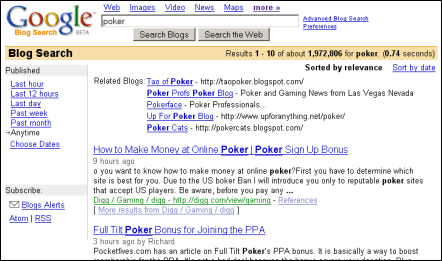
A patent application from Google for “ranking blog documents,” filed in late 2005, is available now. (I don’t see Google Inc mentioned in the paper, but I know that several of the inventors – like Andriy Bihun, Jason Goldman and Vinod Marur – work at Google.) Google presents a couple of positive and negative quality indicators, and it’s possible these are live today at Google’s Blog Search to weed out spammers – in any case, this gives an interesting insight look into Google’s thinking.
Here are some positive factors for blogs:
- The popularity of the blog
- The existence of the blog document in blogrolls
- A high number of unique subscriptions
- Use of tags
- Emails or chat transcripts containing the blog URL (I wonder if Google analyzes Gmail or Google Talk content for such uses?)
- The blog or blog post’s PageRank (Google adds “a blog document (e.g., a post) may not be associated with a pagerank (e.g., when the post is new). In those situations, the new post may inherit the pagerank of the blog with which it is associated until such time that an independent pagerank is determined for the new post.”)
And here are some negative factors:
- New posts being published in short succession, which hints at automation
- Duplicate posts in a blog
- The use words or phrases that often appear in spam
- Very similar length across different posts of the blog
- Lots of links from this blog pointing back to a single website
- Lots of ads
Of course, every spammer can e.g. use tags as well, and some good blogs use a lot of ads, so we should probably think of these indicators as individual ingredients to an overall good blog mixture, without the existence or non-existence of any ingredient on its own making the blog good or bad. E.g. Google may assign a couple of points per attribute depending how much of it is visible, adjust this value by the attribute’s weight, and then compare it to some threshold to decide how to rank the blog (or whether to mark it as spam).
[Via Ionut Alex. Chitu, who saw it at Search Engine Roundtable.]
>> More posts
Advertisement
This site unofficially covers Google™ and more with some rights reserved. Join our forum!