Thursday, September 27, 2007
Google Turns 9
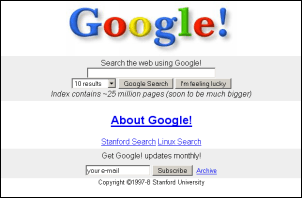
Google.stanford.edu in late 1997. Sergey Brin in 1999 says, “A perfect search engine will process and understand all the information in the world ... That is where Google is headed.”
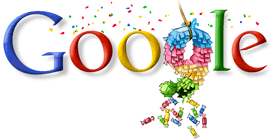
Google.com, a PageRank 10 homepage, turns 9 years old today, according to the special logo put up for the occasion (though many different days can be defined as Google’s birthday, and you may even consider Google to be as old as 12 years, depending where you put the “start” flag). To wrap up the history: Google started as a search engine, and it’s still a search engine today. Of course, it’s also trying to be much more today, in particular, an office suite processing information. But I’m sure we’ll see some more birthday logos before that turns to the kind of mainstream in which today’s market leaders are positioned. And we might see even more birthday logos pass by until Google truly understands information, but according to one of its co-founders, that’s where it’s headed.
In-between being a search engine and staying one, this is what also happened during the last 9 years, in semi-particular order:
- The Google homepage goes out of Beta
- A Google Friends newsletter is started to address “Googlers,” originally the term for Google users
- Google teams up with RealNames to bring now-forgotten Internet Keyword support to their search engine
- Google bought a huge Newsgroup archive from Deja News and turned it into Google Groups. The first mention of Madonna on the internet is now owned by Google Inc.
- Google created a technology playground called Google Labs, where they release tools such as Google Sets
- Yahoo switches to Google results, but later changes their mind and develops their own search engine back-end to compete with Google and Microsoft in the club of the three only high-scale search engines worldwide
- Eric Emerson Schmidt, then 46, replaces Larry Page, then 28 years old, as boss of Google
- Google shows context-relevant AdWords in search results, and later AdSense on external websites
- Aaron Swartz starts posting news on Google on the Google Weblog
- Google releases more and more company blogs to communicate with people outside the company
- Google releases Gmail, which many thought was an April Fool’s prank due to the at the time incredible storage of 1 Gigabyte
- Google went through an Initial Public Offering, meaning the company gets special attention from stock market investors
- Google enters China and decides to compromise its mission by self-censoring human rights websites, proclaiming a change from “don’t ever be evil, period” to “scales balancing what Google thinks is least evil”
- Google releases a set of programming frameworks called GData
- Google releases a set of client-side, ad-powered JavaScript APIs, ditching support for their server-side, ad-free SOAP API
- Google releases a word processor, a spreadsheet editor, and later a presentations tool, all with a focus on online collaboration
- Google publishes their Google Apps suite for companies
- Google starts showing good-resolution photos of people on the streets as part of mining public information and making it accessible
- Google’s co-founder Sergey Brin in a speech given on a Google Developer Day says we’ve come full circle, as the generation which grew up with the web is now starting to create on the web, determining its shape... a self-increasing feedback loop causing exponentially growing development (or so one would hope).
- and much, much more.
The core of Google’s business today is selling micro attention by end users to advertisers. This micro attention is generated via Google’s technology that delivers answers to these end users which help them in their everyday lives. The core of the quality of these answers, in turn, are Google’s complicated algorithms which do three things: trying to understand information, then trying to know when this information is relevant to the user, and then trying to figure out the authoritativeness of a given piece of information.
We can think of the authority problem this way: how do you create a new country? You can get together with ten of your friends and just declare a piece of land you find to be a new country, where you have your own constitution, taxes, and so on. However, this country needs to be recognized by other countries to be an official country. So each of your ten friend’s close family will now create their own country near-by, and you will all cross-recognize each other’s country to make it official. Is yours really a country now or is this a fake set-up?
That authority problem is what Google’s search technology is meant to figure out on the web, where each domain is its own country, and a set of apparently fake countries cross-recognizing each other is called a link farm. But really, there is no clear rule just what the meaning of authority is, because paradoxically you need to determine an authority in the first place to decide on this.
In Google’s world, this “first” authority is sometimes simply Google itself – its programmers, designers, managers, its chosen testers. Sometimes, it’s the government of a country in which Google resides. But more often, pragmatically this authority is also just what the majority of end users think of as the best result for a search query. If you enter “Coca Cola” and end up on Pepsi.com, you will be unhappy and soon switch to another search engine. If you all do, the mass of micro attention needed to power the Google servers which calculate authority every minute of the day will be deprived of their power source. So as you can see, in a way, we all define Google’s algorithms. Or perhaps we, the global consciousness, are part of their algorithm. Sometimes the difference is hard to tell – and maybe to this planet’s evolution, it doesn’t matter either way – but whatever makes it work, after 9 years, the machine is running full steam.
[Thanks Orli and Renê!]
>> More posts
Advertisement
This site unofficially covers Google™ and more with some rights reserved. Join our forum!