
Tuesday, December 8, 2009
Google Real-Time Search Results
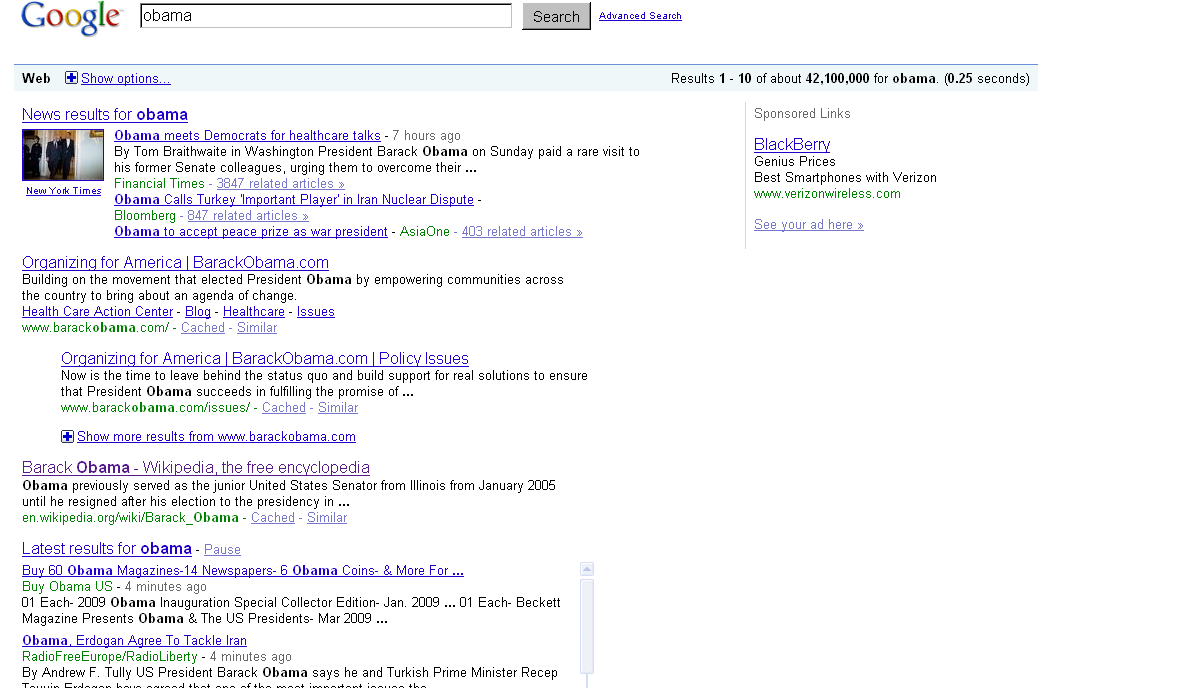
Google has released real-time results integrated into their main web search results. Now, when you enter a query like obama, google and many others, somewhere in the page you might be seeing a dynamically self-updating, scrollable section of bits currently posted over the web. Sources include partners on this like Facebook, Twitter, Friendfeed, as well as general news sites. You might already know this type of smoothly updating news approach from Friendfeed itself, which featured it for a while. At any time you can hit the post button to stop the updates from scrolling in.
When your particular query doesn’t result in a real-time box on its own, you can click on “Show options” at the top and then hit the “Latest” link to make it appear. To see some of the breaking news topics real-time search might cover, you can also look at and search within the new Hot Topics section on Google Trends. Right now, bowl games, tiger and lahore lead these US charts.
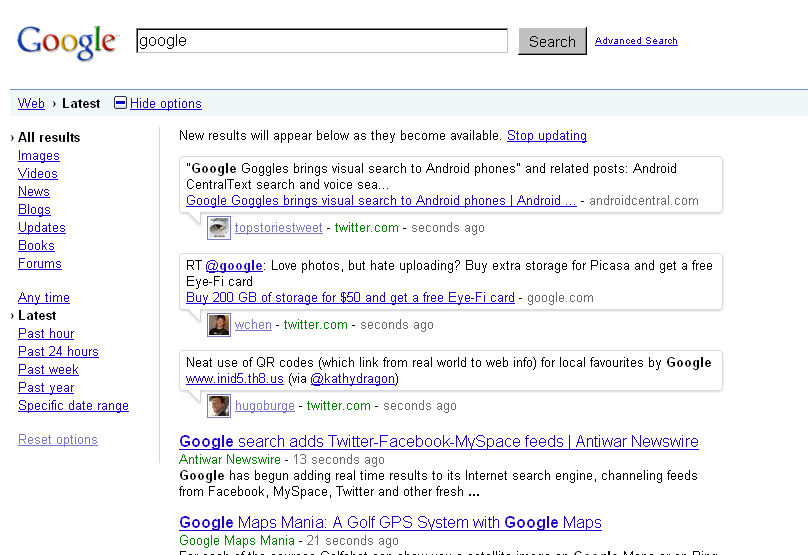
This real-timeness (or what’s close to real-time) looks like it works pretty well, and is yet another rather crucial change to old but not rusty Google happening in the last few days – after just recently, we saw Google overhaul its homepage base design.
It may be noteworthy here that Google specifically partners with several of the real-time sources presented, like Friendfeed or Twitter, as they also emphasize in their blog post on this. Partnerships aren’t quite neutral things – they require human interaction, sometimes contracts, and they may be based on strategical alliances and counter-favors. They may make it harder in the future for third-parties to enter Google’s results in all the meaningful onebox places. Don’t see your business pop up on a map? Well, you didn’t apply for Google’s Local Business Center program! Don’t see your face on a search for your name? Well, you didn’t create a Google Profile yet! Your corrected charts on unemployment rates in your home town aren’t part of Google’s Public Data? Well, only the U.S. Bureau of Labor Statistics looked factual enough to Google’s engineers! You don’t get a neat shopping cart icon? Looks like you use PayPal instead of Google Checkout! No thumbnail for the video you’re daring to host yourself? Why, you didn’t upload it to Google’s YouTube or another supported video site yet! Your publication is not appearing in the Google News onebox? Maybe Google’s human evaluators didn’t find your news site application too convincing!
The list goes on, but you can see the issue: every cool onebox gadget Google releases is also offering leverage for Google to implicitly pressure third-parties to “play by our rules or disappear from our results”. They may also simply not give smaller players the same onebox attention because Google doesn’t deem it worth the time to build special engineering cases for them. A side issue is that Google’s partners may start to offer data to Google alone, mostly through a natural laziness which creates incentive to only feed the biggest player, leaving competition outside outside the data walls. All this is different from saying Google is currently actively using or abusing this specific power (at this moment in time some of us may actually feel lucky that Google, and not a company like Microsoft, is holding this type of power... I’m not sure how many competitors would print links towards Yahoo Finance and MSN Money on their finance gadget like Google still does for stock searches). But it’s something worth keeping in mind for now and the future – especially if you’re competing with Google or Google’s partners in any space.
[Thanks Mbegin and BizAbh!]
>> More posts
Advertisement
This site unofficially covers Google™ and more with some rights reserved. Join our forum!